


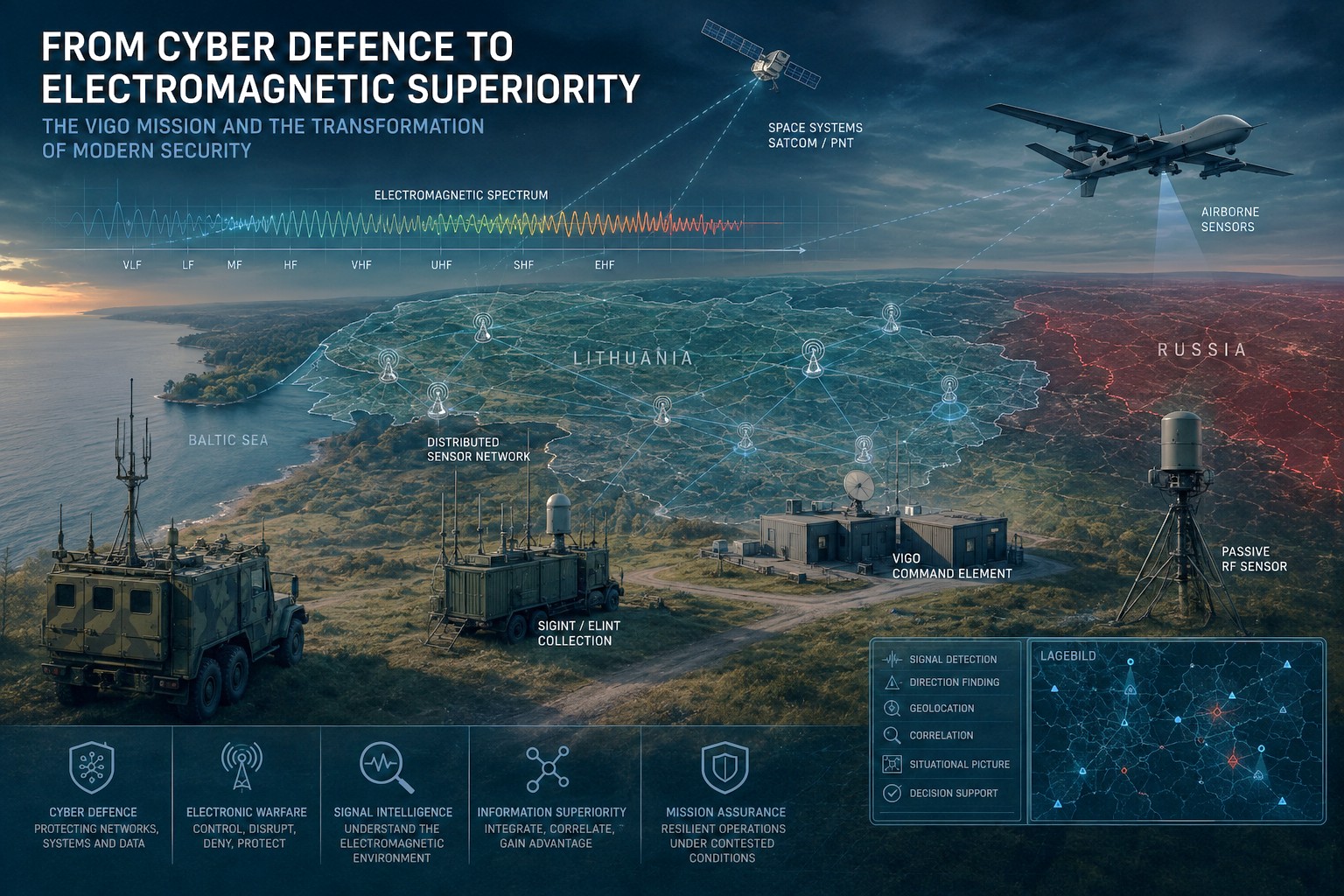
Symbolic illustration; AI-generated.
1. Strategic Context: From Network Protection to the Contest for Information Superiority
The digitalisation of armed forces has transformed not only military technology, but also the nature of military vulnerability. Modern command-and-control systems, intelligence and reconnaissance assets, air-defence networks, uncrewed platforms, satellite navigation and essential logistics infrastructure all depend on digital networks, software, radio-frequency links and the continuous exchange of data. The ability to collect, process, protect and transmit information within the relevant operational window has therefore become a decisive element of military effectiveness.
This development also broadens the conventional understanding of cybersecurity. Protecting military digital infrastructure can no longer be reduced to defending computers and fixed networks against unauthorised access. Digital systems are connected to the electromagnetic spectrum through radio communications, radar, satellite links, positioning and navigation signals, and the command links used by uncrewed systems. Disrupting or manipulating these signals can impair mission performance even when the underlying software and internal networks remain uncompromised.
Modern defence architectures consequently bring together capabilities that were once treated largely as separate operational fields: cyber operations, electronic warfare (EW; Elektronische Kampfführung, EloKa), signals intelligence (SIGINT), secure communications and advanced data analysis. These disciplines remain technically and organisationally distinct, but their operational effects increasingly converge. Their common purpose is to preserve access to reliable and timely information, maintain situational awareness and support sound decision-making in a contested electromagnetic environment.
The strategic importance of this convergence has grown steadily across Europe. Since February 2022, the full-scale war in Ukraine has demonstrated the operational significance of coordinating conventional combat power with cyber operations, electronic warfare, uncrewed systems, space-based capabilities and information operations. For European defence planners, cyber and electromagnetic resilience are therefore no longer specialised supporting functions. They have become essential components of national and collective defence.
Germany began consolidating these capabilities before 2022. In 2017, the Bundeswehr established the Cyber and Information Domain Service (CIDS; Cyber- und Informationsraum, CIR) as a distinct military organisational area. It brought together capabilities in military information technology, cyber operations, signal-based reconnaissance, geoinformation support and electronic warfare that had previously been distributed across different parts of the armed forces. Institutional consolidation, however, represents only the foundation of operational capability. Effective employment also requires interoperable command-and-control systems, trained personnel, reliable information-sharing procedures and the ability to convert collected data into timely intelligence for military decision-makers.
During the early 2020s, CIDS capabilities became more closely integrated into NATO’s collective-defence posture. From 2021 onwards, CIDS elements prepared to support Germany’s contribution to the Very High Readiness Joint Task Force in 2023. These preparations involved deployable information technology, geoinformation support, electronic warfare capabilities, mobile command-post infrastructure and secure communications under field conditions. The process reflected a broader transition from structures primarily shaped by expeditionary operations towards forces increasingly designed for territorial and alliance defence.
The Zeitenwende announced by Federal Chancellor Olaf Scholz on 27 February 2022 accelerated this reorientation. Cyber, information and electronic-warfare capabilities assumed a more prominent role in Germany’s approach to national and collective defence. A further institutional step followed in April 2024, when the CIDS was elevated from a military organisational area to an independent service branch alongside the Army, Air Force and Navy.
From an information-security perspective, this operational logic extends the practical application of the traditional CIA triad of confidentiality, integrity and availability. Military information must be protected against unauthorised disclosure and alteration while remaining accessible when required. In a tactical environment, however, its value also depends on timeliness. Latency should therefore be understood not as a formal replacement for the CIA model, but as an additional measure of mission effectiveness. Intelligence may be accurate, authentic and securely transmitted, yet still be operationally useless if it arrives after the relevant decision window has closed.
Cybersecurity in the CIDS context consequently extends beyond conventional perimeter defence. It must protect the full information chain: from collection at the electromagnetic edge, through processing and transmission, to analysis, presentation and operational use. The objective is not merely to secure individual devices, but to ensure that information remains trustworthy, available and actionable under contested conditions.
Germany’s VIGO (Vigilant Owl) mission in Lithuania provides a practical example of this development. VIGO is neither a radar system nor a single SIGINT platform. It is an electromagnetic reconnaissance mission that combines mobile collection capabilities, command and information systems, supporting elements and close cooperation with Lithuanian forces to strengthen situational awareness and force protection on NATO’s eastern flank. Public Bundeswehr reporting also documents the use of mobile sensors and uncrewed systems within the mission, although the precise internal architecture and technical integration of these components are not publicly disclosed.
One of the systems employed during VIGO is Baumfalke, a mobile reconnaissance prototype designed to detect and geolocate radio signals. The Bundeswehr has confirmed that Baumfalke uses Time Difference of Arrival to narrow down the origin of intercepted emissions and that the resulting information can be forwarded to higher command in real time. This does not by itself establish the existence of a fully automated sensor-to-shooter architecture or the automatic integration of every sensor feed into a single Common Operational Picture. It does, however, demonstrate the operational importance of moving relevant information from collection to command quickly enough to support further reconnaissance and decision-making.
VIGO therefore represents more than another iteration of an exercise series. It reflects the institutionalisation of a reconnaissance posture that is designed for sustained availability but activated temporarily in response to the operational situation and in coordination with Lithuania. The central analytical question is no longer whether an individual server, sensor or radio link is adequately protected. It is whether the entire sensor-to-decision chain—from physical signal detection and geolocation to data transmission, interpretation and operational presentation—can continue to produce sufficiently trusted information under peer-level cyber and electromagnetic disruption.
2. The Electromagnetic Spectrum as an Intelligence Source and a Contested Domain
Institutional reorganisation provided the structural foundation of the CIDS, but its operational effectiveness depends heavily on the ability to observe, use and contest the electromagnetic spectrum (EMS). Modern armed forces inevitably produce an electromagnetic footprint. Tactical radio networks, radar installations, satellite communications, positioning and navigation services, and the data links used by uncrewed aerial systems all rely on electromagnetic signals.
Even where communications are encrypted and their contents remain inaccessible, signal parameters and patterns of activity can still provide valuable intelligence. Relevant indicators include transmission frequency and duration, changes in frequency use, modulation characteristics, pulse repetition intervals, polarisation, signal strength and lines of bearing. When observed over time and correlated with other information, these characteristics can reveal changes in unit activity, network structure and operational posture.
The electromagnetic spectrum is therefore both an intelligence source and a contested operational environment. Signals intelligence (SIGINT) exploits emissions to produce intelligence, while electromagnetic warfare (EW; Elektronische Kampfführung, EloKa) uses the spectrum to build situational awareness, create effects and protect friendly freedom of action. The two fields overlap in their dependence on signal collection and analysis, but they differ in purpose, tasking, legal authority and operational use.
SIGINT as an Umbrella Discipline: COMINT and ELINT
Signals intelligence encompasses the interception, processing and analysis of foreign communications and non-communications signals. It is not a single platform or sensor, but an intelligence discipline supported by multiple collection systems and analytical processes. For the purposes of this analysis, two branches are particularly relevant: Communications Intelligence (COMINT) and Electronic Intelligence (ELINT).
Communications Intelligence (COMINT) concerns signals used to transmit voice, data or other communications. Its value does not depend solely on decrypting message content. Traffic analysis can examine when and how often transmissions occur, how long they last, which frequencies are used, whether frequency-hopping patterns change, where transmitters are located and how communication relationships develop over time. These observations can support assessments of command relationships, unit activity and possible operational intent without requiring access to the underlying plaintext or penetration of the target’s internal information systems.
Electronic Intelligence (ELINT) focuses on non-communications emissions, particularly those produced by radar and air-defence sensors. An active radar must radiate electromagnetic energy to perform its function and therefore creates a technically detectable signature. Analysis of carrier frequencies, waveform characteristics, pulse widths, pulse repetition patterns, modulation methods and antenna scan rates can support the identification of a radar type and its operating mode, such as search, tracking or target illumination. When combined with historical data and operational context, these observations may also support assessments of the system’s deployment and readiness.
One important German capability in this field is the TPz Fuchs KWS RMB (Kampfwertsteigerung Radio Multiband). The Bundeswehr publicly describes the vehicle as a mobile system capable of detecting, direction-finding and evaluating radar signals. Observations collected by such systems can contribute to the construction and continuous updating of an Electronic Order of Battle (EOB): a structured representation of relevant emitters, their locations, technical characteristics, operating patterns and relationships to wider radar or air-defence networks within the monitored area.
The distinction between COMINT and ELINT is important for understanding VIGO. COMINT derives intelligence from communications activity, whereas ELINT examines non-communications emissions, especially radar signatures. In both cases, collection begins with signals present in the physical electromagnetic environment rather than with the exploitation of a software vulnerability or unauthorised access to an internal network.
Electromagnetic Warfare: From Surveillance to Operational Effects
Whereas SIGINT is primarily directed towards producing intelligence, electromagnetic warfare has a broader operational purpose. NATO describes EW as the combat arm of Electromagnetic Operations (EMO): military activity that exploits electromagnetic energy to provide situational awareness and generate offensive or defensive effects.
EW is commonly organised around three related functions. Electromagnetic Surveillance (ES) detects, intercepts, identifies, analyses and locates electromagnetic emissions in support of immediate threat recognition and situational awareness. Electromagnetic Attack (EA) uses electromagnetic energy to degrade, disrupt, deceive, deny or neutralise an adversary’s effective use of the spectrum. Electromagnetic Defence (ED) protects friendly personnel, platforms and systems against electromagnetic attack, interference and other spectrum-related hazards while preserving friendly access to the EMS.
The boundary between SIGINT and electromagnetic surveillance is not defined solely by the sensor or signal involved. The same emission may be collected for long-term intelligence analysis or used immediately to warn a commander, cue another sensor or support an electromagnetic action. The distinction lies largely in the operational purpose, authority, processing timeline and intended user of the resulting information.
NATO’s adoption of the broader concepts of Electromagnetic Warfare and Electromagnetic Operations reflects the growing complexity of the electromagnetic environment. Military systems no longer operate through isolated transmitters and receivers. They function across interconnected military, civilian, commercial and space-based infrastructures whose signals overlap in frequency, geography and purpose. Contesting the spectrum therefore affects communications, navigation, sensing, command and control, and the digital systems that depend on them.
This relationship exposes a fundamental vulnerability: digital hardening does not by itself guarantee electromagnetic survivability. A communications channel protected by strong encryption can still be rendered unavailable by effective jamming. An air-gapped mission computer may remain dependent on externally supplied positioning, navigation and timing information. Likewise, robust onboard software cannot prevent an uncrewed platform from losing mission capability if its command link is denied or its navigation inputs are manipulated. A system can therefore be degraded or neutralised without the attacker exploiting a single line of software code.
Cyber Operations and Electromagnetic Warfare: Distinct Mechanisms, Converging Effects
Analysing modern military systems requires a clear functional distinction between cyber operations and electromagnetic warfare. Cyber operations act through data, software, computing environments, digital identities and network protocols. Electromagnetic warfare acts through the physical electromagnetic environment to detect, exploit, manipulate or deny spectrum-dependent functions.
The distinction is technological rather than absolute at the system level. At the physical signal layer, jamming, electromagnetic deception and the manipulation of radio-navigation signals are primarily electromagnetic mechanisms. At the network and data-link layer, route manipulation, malicious traffic injection, exploitation of authentication weaknesses and man-in-the-middle attacks operate against logical communications processes and are therefore primarily cyber mechanisms, even when the affected network uses radio as its transmission medium. At the software and application layer, malware, software exploitation and the unauthorised alteration of data are clearly cyber effects.
These mechanisms can nevertheless be combined. Electromagnetic action may create the conditions for a cyber operation by denying a legitimate link, forcing a system onto a less secure fallback channel or enabling access to a wireless interface. Conversely, compromised software may alter the behaviour of a radio, radar or navigation system and thereby create effects in the electromagnetic environment. The appropriate classification therefore depends on how the effect is produced, not merely on whether the targeted system uses radio frequencies.
A tactical radio illustrates this convergence particularly well. It is simultaneously an RF transmitter, a network endpoint and a software-defined processing system. An uncrewed aerial system combines avionics, flight-control software, navigation inputs, onboard sensors and one or more radio-frequency data links. Radar observations are processed by embedded computers and may then be distributed through tactical IP networks. Cyber and electromagnetic capabilities can consequently affect different layers of the same mission system while producing similar operational consequences: degraded situational awareness, delayed decisions, loss of control or complete mission failure.
The central principle is therefore straightforward: cyber operations and electromagnetic warfare remain technologically distinct, but their operational effects can converge within the same mission system.
The Intelligence Processing Chain: From Raw Emission to the Operational Picture
Detecting an isolated emission provides limited tactical value. The signal must be measured, contextualised and converted into an intelligence product before it can support an operational decision. A simplified processing chain can be represented as follows:
Detection → Interception and measurement → Direction-finding or geolocation → Characterisation → Classification → Correlation and fusion → Reporting or operational display
Each stage adds information and reduces uncertainty. Direction-finding systems estimate the direction from which a signal arrives and produce a line of bearing. Bearings obtained from spatially separated sensors can be intersected to estimate an emitter’s position. Time Difference of Arrival (TDOA), by contrast, calculates differences in signal arrival time across synchronised receivers and produces hyperbolic lines of position. Angle of Arrival (AoA), TDOA and other measurements may be combined to improve the estimated location and define an uncertainty area rather than an unrealistically exact point.
Continued spectrum observation can also establish a baseline of normal activity. Deviations from this baseline—such as unusual transmission density, altered frequency use, new waveform characteristics or sudden bursts of activity—may indicate a change in operational behaviour. Automated analytical tools can assist in detecting these anomalies, but their findings still require contextual evaluation.
Correlation with other intelligence disciplines can further reduce uncertainty. An ELINT detection may be compared with optical or infrared imagery, radar tracks, geospatial information and historical EOB data. Such fusion does not automatically prove that a particular platform or surface-to-air missile battery is present. It can, however, increase confidence in a classification, identify inconsistencies and guide further collection by another sensor.
Operational performance is therefore determined by more than receiver sensitivity. It also depends on sensor geometry, timing accuracy, data quality, false-alarm rates, communication availability, processing capacity, analytical workflow and the time required to present the result to the relevant decision-maker. The critical measure is sensor-to-decision latency: the interval between the initial observation and the point at which sufficiently reliable information becomes available for operational use.
Automated signal processing, edge computing and machine-assisted classification can shorten this interval by filtering large volumes of RF data and prioritising potentially relevant emissions. Their use should not, however, be interpreted as evidence that every contemporary EW deployment employs fully autonomous classification or direct, automated injection into a Common Operational Picture.
This processing chain provides the analytical framework for examining Vigilant Owl, now institutionalised as the VIGO mission. Public sources confirm the use of mobile electromagnetic reconnaissance systems, signal geolocation, operational reporting and cooperation with other reconnaissance assets. They do not disclose a complete technical architecture or establish that all collection, fusion and visualisation processes are fully automated. VIGO should therefore be assessed as an operational case in which elements of the sensor-to-decision chain are publicly visible, while its internal implementation remains only partially documented.
3. NATO’s Eastern Flank: From Vigilant Owl to the VIGO Reconnaissance Mission
Signals intelligence (SIGINT) and electromagnetic warfare (EW) capabilities provide their greatest operational value when they are employed within a clearly defined geographical context and integrated with the military formations that depend on their findings. Lithuania represents a particularly important operational setting in this respect. Situated on NATO’s north-eastern flank, it borders Belarus and the heavily militarised Russian exclave of Kaliningrad and lies adjacent to the strategically important Suwałki Gap. Its location makes the country highly relevant to electromagnetic reconnaissance, early warning and the development of allied situational awareness.
Radio-frequency emissions do not conform to political borders. Their propagation is determined by physical factors such as frequency, transmitter power, antenna characteristics, atmospheric conditions, elevation and terrain masking. Passive sensors positioned on Lithuanian territory can therefore detect and analyse emissions originating beyond NATO’s borders, provided that propagation conditions and sensor geometry permit. Such stand-off collection can contribute to the identification and localisation of radar, air-defence and communications emitters without requiring reconnaissance platforms to enter foreign territory or airspace.
The Evolution of German-Lithuanian Cooperation in Electromagnetic Warfare
German-Lithuanian cooperation in electromagnetic warfare initially developed through the Vigilant Owl exercise series. German EW units have conducted the exercise in Lithuania since 2020, while annual activities based on a bilateral agreement have taken place since 2021. The early iterations concentrated on deploying specialised reconnaissance systems, operating them under realistic electromagnetic conditions and improving interoperability between German and Lithuanian personnel. Training also supported Lithuania’s development of its own electromagnetic-warfare capabilities.
Following Russia’s full-scale invasion of Ukraine in February 2022, this cooperation acquired greater strategic importance. NATO’s broader transition towards forward defence increased the relevance of persistent situational awareness along the Alliance’s eastern flank. German and Lithuanian personnel expanded their practical cooperation in radar reconnaissance, including the use of the TPz Fuchs KWS RMB (Radio Multiband). The system can passively detect, locate and evaluate radar emissions, thereby contributing to the recognition and assessment of potentially relevant emitters. Publicly available information does not, however, establish that these deployments formed a permanently operating or theatre-wide surveillance network.
A further institutional development followed in 2025. Panzerbrigade 45, the core of Germany’s Brigade Lithuania, was formally activated on 1 April 2025, with its ceremonial establishment taking place in Vilnius on 22 May. The brigade is being permanently stationed in Lithuania and is intended to reach full operational readiness by the end of 2027. Its gradual build-up creates a sustained requirement for timely intelligence, early warning and force protection, including awareness of activities in the electromagnetic spectrum.
Against this background, the name Vigilant Owl was carried from the exercise series into VIGO, which the Bundeswehr now identifies as the first formally recognised mission of the Cyber and Information Domain Service. This development should not be understood as the simple conversion of an annual exercise into uninterrupted electromagnetic surveillance. According to the Bundeswehr, VIGO is established on a lasting basis but activated for limited periods in response to the security situation and in coordination with Lithuania. It therefore represents an institutionalised and repeatable reconnaissance mission rather than a continuously operating permanent deployment.
VIGO as an Integrated Reconnaissance Mission
VIGO is neither a radar installation nor a single SIGINT platform. Public Bundeswehr reporting presents it as an integrated mission structure in which specialised personnel, mobile reconnaissance systems, unmanned platforms, communications elements and command facilities operate in conjunction with Lithuanian forces.
Mobile electromagnetic-reconnaissance assets detect, analyse and locate relevant emissions. Uncrewed systems support surveillance and the protection of deployed positions, while the mission’s command post coordinates its different elements and brings together reconnaissance findings and other operational information. Deployable communications teams establish secure local networks so that relevant information can reach the appropriate command level without unnecessary delay. Together, these components contribute to a more comprehensive operational picture.
This description supports an analytical understanding of VIGO as a networked reconnaissance arrangement. It does not, however, confirm the existence of a fully automated sensor-fusion architecture, a dedicated sensor-to-shooter network or a technically specified data mesh. Public sources do not disclose the mission’s internal network topology, cryptographic implementation, data-processing architecture or degree of automation. Any assessment of these features must therefore remain at the functional and architectural level.
One notable asset employed within VIGO is the mobile Baumfalke prototype. Developed with support from the Bundeswehr Cyber Innovation Hub, the system detects and passively geolocates radio signals and can be operated either dismounted or from a vehicle. During VIGO, its measurements were used to narrow down the origins of detected transmissions, and relevant findings were passed to higher command in real time. The system does not independently establish the identity or operational context of every detected emitter; additional reconnaissance may be required to determine who is transmitting and from which platform.
Baumfalke nevertheless illustrates a central principle of network-enabled reconnaissance: the operational value of a sensor depends not only on its ability to detect and locate a signal, but also on whether its findings can be transmitted rapidly, correlated with other information and interpreted within the wider operational context. An individual measurement provides only a limited indication. Its tactical value emerges when it contributes to a broader and sufficiently reliable picture of the situation.
4. VIGO Architecture: From Raw Signals to the Common Operational Picture
The effectiveness of modern intelligence systems cannot be assessed solely in terms of individual sensor performance. It also depends on how quickly, accurately and reliably sensor outputs can be evaluated, transmitted and placed within a broader operational context. A technically accurate observation has limited value if it arrives too late, cannot be correlated with other information or loses its integrity during processing and transmission.
Public Bundeswehr reporting describes VIGO as a mission involving several mobile sensor systems, deployable communications networks, unmanned systems and a command post in which reconnaissance findings and other operational information are brought together. This provides evidence of a functional sensor-to-command chain. It does not, however, establish that VIGO operates as a fully automated data mesh or that all collected information is processed through a single integrated multi-sensor fusion platform. The precise network topology, processing architecture and degree of automation have not been publicly disclosed.
Within this mission structure, the mobile Baumfalke prototype performs a specialised collection and geolocation function. The system originated from an initiative within Electronic Warfare Battalion 932 and was developed through the Bundeswehr Cyber Innovation Hub’s intrapreneurship programme. It consists of compact sensor units that can be distributed across an area, remotely controlled and connected through a low-power radio network. These sensors detect radio emissions and compare their arrival times to estimate the location of the transmitting source. The resulting location data can then be transferred automatically to the Bundeswehr’s evaluation systems.
Functionally, Baumfalke can therefore be understood as a tactical edge-collection system: it performs measurement and initial geolocation close to the point of collection before forwarding its results for further evaluation. Public sources do not provide its operating frequency range, receiver sensitivity, timing source, location accuracy or internal processing architecture. These parameters should consequently be treated as undisclosed rather than assumed to possess any classified specification.
Passive Geolocation Using Time Difference of Arrival
The publicly documented geolocation method used by the Baumfalke system is Time Difference of Arrival (TDOA). Several spatially separated sensors receive the same radio signal at slightly different times. Using these time differences together with the known positions of the sensor nodes, the system applies hyperbolic multilateration to estimate the probable origin of the emission. The process can be represented in simplified form as follows:
Emission → time-offset reception by distributed sensors → calculation of arrival-time differences → position estimate → forwarding for analysis
The method does not inherently produce an exact coordinate, but rather a position estimate. Its quality depends on factors including sensor geometry, clock synchronisation, the accuracy of the sensor coordinates, signal-propagation conditions and possible reflections. Nor can geolocation alone reliably determine who transmitted the signal or which platform carries the transmitter. Additional intelligence and further operational assessment are required to establish that context.
From a cybersecurity perspective, the principal concern is the system’s dependence on trustworthy timing, positioning and measurement data. Manipulated timestamps, falsified sensor coordinates, disrupted communications or altered measurement data could impair the geolocation process and distort the resulting operational picture. The integrity of the location estimate therefore depends not only on the performance of the RF sensors, but also on the security and resilience of the supporting data-transmission and processing infrastructure. Publicly available information does not disclose the specific timing and synchronisation architecture used by Baumfalke.
Operational Advantages and Tactical Constraints
Passive geolocation offers an important operational advantage because the collection function itself does not require the sensor to transmit towards the emitter. This reduces the electromagnetic signature associated with active radar or other radiating reconnaissance methods. It would nevertheless be inaccurate to describe a complete TDOA system as having a “zero RF signature”. Baumfalke’s distributed sensors communicate through a low-power radio network, and control or data-transmission links may themselves generate detectable emissions. Passive sensors may also be discovered through visual observation, electronic surveillance of supporting communications, cyber compromise or physical reconnaissance.
The sensors’ compact and mobile design allows their deployment geometry to be adapted to terrain and operational requirements. Greater separation between receivers can improve geolocation performance under suitable conditions, but only if the nodes remain accurately positioned, sufficiently synchronised and connected. Terrain masking, vegetation, urban reflections, non-line-of-sight propagation, poor sensor geometry and emitter movement can all reduce accuracy or produce misleading results.
TDOA also determines the probable origin of an emission, not necessarily the identity of the transmitter or the platform carrying it. A detected VHF transmission may indicate where a signal originated without establishing whether it came from a military radio, a civilian installation, a border patrol or another source. Technical signal characteristics and historical observations can support classification, but positive identification may require additional reconnaissance. Bundeswehr reporting on VIGO explicitly notes that Baumfalke findings may be supplemented by drones or personnel operating in the relevant area.
Data Integration and Command-Level Situational Awareness
A location estimate becomes operationally useful only when it is evaluated, placed in context and delivered to the appropriate command level. Public reporting confirms that Baumfalke can transmit its location results automatically to military evaluation systems and that findings generated during VIGO have been forwarded to higher command in real time. It also confirms that reconnaissance results and other information converge at the mission’s command post, while deployable communications elements provide the necessary network connectivity.
A defensible representation of the publicly documented processing chain is therefore:
Detection → TDOA geolocation → technical evaluation → transmission → correlation with other information → operational picture → command decision
This sequence should be distinguished from a confirmed, fully automated Multi-Sensor Data Fusion architecture. In principle, correlating RF geolocation results with radar reporting, imagery, observations from unmanned systems and historical emitter records can reduce false alarms and improve classification. It may also help distinguish routine civilian activity from operationally relevant emissions. Public sources do not disclose which of these data sources are technically integrated within VIGO, which correlations are automated or whether its outputs are inserted directly into a NATO-wide Common Operational Picture.
The publicly documented architecture nevertheless reveals several critical dependencies. TDOA requires sufficiently accurate timing, reliable knowledge of sensor positions and communication between distributed nodes. Subsequent processing depends on the availability and integrity of evaluation systems, data links and command networks. Disruption at any of these stages can delay results, reduce location accuracy or undermine confidence in the resulting operational picture.
This is where electromagnetic warfare and cybersecurity intersect. Electromagnetic reconnaissance produces the initial observations, while digital systems process, transmit and contextualise them. The credibility of the final operational picture therefore depends not only on the quality of the RF measurements, but also on the integrity, authenticity, availability and timely delivery of the data throughout the entire reconnaissance chain.
5. Cybersecurity in Distributed Intelligence Architectures: Establishing Trust in the Common Operational Picture
The operational value of distributed reconnaissance increases as sensors, evaluation systems, communications nodes and command elements become more closely interconnected. Observations can be transmitted more rapidly, correlated with other information and incorporated into an operational picture that supports command decisions. The same interconnectivity, however, also creates additional dependencies and expands the potential attack surface.
Public reporting on VIGO confirms that reconnaissance findings are forwarded to higher command in real time, that several types of information converge at a command post and that deployable networks connect the participating elements. It does not disclose a complete technical architecture or confirm direct integration into a NATO-wide Common Operational Picture (COP). In the following analysis, the COP therefore refers more broadly to the shared operational representation produced from available intelligence and used to support decision-making.
A distributed SIGINT and electromagnetic-warfare architecture extends beyond conventional IT infrastructure. It may include RF sensors, the electromagnetic propagation environment, positioning and timing services, tactical processing systems, wireless and wired data links, evaluation software and human operators. Security must therefore cover the complete path from physical signal reception to the presentation of an assessed result.
Protecting the network against unauthorised access is not sufficient if the information reaching commanders has been delayed, replayed, falsified or stripped of essential context. The cybersecurity objective is consequently not limited to protecting individual devices. It must preserve the integrity, authenticity, availability and operational timeliness of the entire reconnaissance and decision-support chain.
Physical and RF-Layer Vulnerabilities
Radio-frequency sensors and wireless links depend on signals received through an environment that cannot be enclosed by a conventional network perimeter. An adversary may therefore degrade the mission at the physical layer without exploiting software vulnerabilities or gaining access to internal systems.
RF jamming primarily threatens availability. Broadband interference can raise the noise floor across a wide frequency range, while spot or responsive jamming can concentrate energy against selected channels. Depending on its power, location and waveform, interference may mask relevant emissions, reduce receiver performance or disrupt wireless data links. It does not necessarily render every passive sensor inoperative, but it can reduce the quality and completeness of the collected information.
Signal spoofing threatens integrity and authenticity. An adversary may transmit counterfeit signals designed to appear legitimate to a receiver. GNSS spoofing, for example, can produce false position or timing information in systems that rely on satellite-based positioning or synchronisation. Such manipulation could affect the coordinates of distributed sensor nodes or the timing data required for multilateration. Public information does not establish whether or to what extent Baumfalke depends on GNSS, so this represents a general architectural risk rather than a confirmed system-specific vulnerability.
Electromagnetic deception threatens interpretation and operational context. Decoy emitters and programmable RF sources can imitate selected characteristics of communications or radar systems. Their purpose may be to create false activity, conceal genuine deployments or consume analytical attention. The effectiveness of such deception depends on whether the fabricated emission remains credible when compared with other observations and historical patterns.
Correlation between independent sources can therefore serve as a validation mechanism. A radio-frequency location that conflicts with imagery, radar reporting or observations from personnel may warrant additional examination. Such inconsistency is not, by itself, proof of hostile manipulation: it may also result from propagation effects, sensor error, stale information or differing update intervals. Its defensive value lies in revealing uncertainty before an unverified observation is accepted into the operational picture.
Data Integrity and Cryptographic Provenance
Even a correctly captured signal remains vulnerable after collection. Measurement data may be modified, replayed, deleted, delayed or associated with false metadata as they pass through processing and communications systems. A simplified data path can be represented as follows:
Collection → preprocessing → transmission → ingestion → correlation and analysis → operational picture
Encryption protects confidentiality during transmission but does not by itself establish the origin, freshness or reliability of the information. Distributed reconnaissance systems also require authenticated sensor identities, integrity protection, secure key management and mechanisms that detect replayed or out-of-sequence messages. Accurate timestamps and controlled handling of location metadata are particularly important where several sensor observations must be correlated.
Data provenance provides the traceability needed to assess how an operational result was produced. Relevant provenance records may include the identity and status of the originating sensor, the time and location associated with the observation, available calibration or health information, the software or algorithm version used during processing and any subsequent transformation or analyst intervention. Cryptographic signatures, message-authentication mechanisms and tamper-evident logs can protect these records against unauthorised alteration.
This does not mean that cryptographic keys themselves should accompany the intelligence product. Rather, systems should retain sufficient key identifiers, certificate information and validation records to establish which trusted identity authenticated the data at a particular stage. The objective is to allow a displayed track or assessment to be traced back through its processing history without exposing the cryptographic material used to protect it.
Public sources do not disclose whether VIGO implements this level of provenance or which cryptographic controls are used. These measures therefore constitute analytical security requirements for distributed intelligence architectures rather than confirmed features of the mission.
Architectural Hardening: Zero Trust and Supply-Chain Governance
Zero Trust Architecture, formalised in NIST Special Publication 800-207, provides a useful analytical benchmark for protecting distributed nodes. Its central principle is that users, devices and services should not receive implicit trust solely because of their network location, ownership or previous access. Authentication and authorisation should instead be based on verified identity, device state, policy and the context of each access request.
Applied to a tactical architecture, this approach favours least-privilege access, separation of functions and the containment of compromised components. Segmentation can restrict the systems and data accessible to an individual sensor or processing node, reducing the potential for lateral movement if that component is captured or digitally compromised. Zero Trust cannot guarantee containment, and its implementation must account for intermittent connectivity, limited bandwidth and the need to continue operating when central policy services are unavailable. Tactical systems therefore require both strong access control and carefully designed procedures for degraded operation.
Security must also extend across the platform lifecycle. NIST SP 800-161 Rev. 1, including its 2024 update, provides a framework for identifying, assessing and mitigating cybersecurity risks associated with products, services and suppliers. For distributed reconnaissance systems, these risks may affect sensors, processors, firmware, operating systems, analytical software, communications components and maintenance services.
Hardware and firmware assurance may include supplier assessment, component provenance, configuration baselines, signed firmware, controlled update processes and verification before deployment. These measures reduce the likelihood that counterfeit components, malicious functionality or vulnerable firmware will enter operational service, although no individual control can eliminate supply-chain risk.
A Software Bill of Materials (SBOM) provides an inventory of the software components and dependencies contained in a product. It can support vulnerability identification, impact assessment and patch prioritisation, but it does not prove that the software is secure or remove vulnerabilities automatically. Air-gapped or intermittently connected systems remain exposed to supply-chain compromise and require controlled procedures for software transfer, verification and updating.
Command-Node Redundancy and Cyber Resilience
Command posts and tactical operations centres are high-value nodes because reconnaissance findings, communications and decision-making converge within them. This concentration creates a potential single point of failure even when the individual sensors remain operational.
Cyber resilience extends the security objective beyond preventing compromise. It is the ability of an architecture to absorb electronic or cyber disruption, preserve mission-essential functions under degraded conditions and restore broader capability within an operationally acceptable period. Redundancy, diversity, recoverability and rehearsed fallback procedures are therefore as important as preventive controls.
Defence in depth should address each layer of the reconnaissance and decision chain. At the electromagnetic layer, appropriate measures may include emission control, waveform diversity, directional transmission and resistance to interference. At the network layer, alternative communication paths, segmented architectures, mutually authenticated nodes and PACE—Primary, Alternate, Contingency and Emergency—communications planning can reduce dependence on a single route or service. At the data layer, integrity protection, anti-replay mechanisms, provenance records, secure logging and consistency checks help preserve trust in the information being processed.
The human and cognitive layer is equally important. Commanders and analysts should be able to see the age, origin and assessed confidence of important information, as well as unresolved contradictions between sources. Manual procedures and alternative reporting channels must remain available when automated correlation or digital visualisation is degraded. This limits the risk that technically plausible but manipulated information will be accepted without sufficient scrutiny.
Ultimately, the principal asset under protection is neither an individual receiver nor a command-post server. It is the decision-maker’s justified confidence in the operational picture. Mission assurance depends on preserving a sufficiently accurate, current and trustworthy representation of the operational environment even when parts of the underlying sensor and communications architecture are disrupted or compromised.
6. Conclusion: VIGO as a Case Study in Resilient Cyber-Electromagnetic Architectures
VIGO illustrates a broader shift in military reconnaissance: operational effectiveness depends increasingly on the integration of sensors, communications, processing systems and command elements rather than on the specifications of an individual platform. Signals intelligence, including COMINT and ELINT, derives indicators from the electromagnetic environment; mobile systems such as Baumfalke use Time Difference of Arrival (TDOA) to estimate the origin of radio emissions; uncrewed systems can support observation and force protection; and deployable communications networks forward reconnaissance findings to command elements for evaluation and operational use.
The publicly documented components of VIGO demonstrate this functional sensor-to-command logic. They do not, however, establish the existence of a fully automated sensor-to-shooter architecture or seamless integration into a NATO-wide Common Operational Picture. VIGO should therefore be treated as an operational case study through which the dependencies of distributed reconnaissance can be examined, rather than as a completely documented reference architecture.
The functional sequence can be represented as follows:
Physical RF emission → detection and geolocation → technical evaluation → forwarding → correlation and assessment → operational picture → command decision
The decisive characteristics of this chain are latency, fidelity and resilience. A highly capable sensor provides limited tactical value if its findings arrive too late, cannot be placed in context or are modified without detection during transmission and processing. Defence analysis must therefore look beyond platform performance and assess the availability, integrity and recoverability of the wider information architecture.
Cybersecurity as a Strategic Enabler in Contested Environments
In distributed reconnaissance architectures, cybersecurity extends beyond administrative IT support. It becomes an operational enabler whose purpose is to preserve sufficiently trustworthy, available and timely intelligence during electronic interference, cyberattack, equipment failure or the loss of individual nodes.
Cyber and electromagnetic attacks remain technologically distinct, and identifying the originating mechanism is essential for selecting an effective countermeasure. Their operational consequences can nevertheless converge. RF jamming may prevent a sensor or data link from receiving a signal; manipulation of positioning or timing data may distort a measurement; route hijacking or packet injection may alter data in transit; and software exploitation may compromise its processing or presentation. Each mechanism can ultimately produce a delayed, incomplete or misleading operational picture.
The resulting effect is not necessarily complete decision paralysis. More commonly, it may reduce confidence, slow the decision cycle, force commanders to rely on incomplete information or create opportunities for incorrect assessment. Cybersecurity must therefore protect not only systems and networks, but also the quality and credibility of the decisions they are intended to support.
Architectural Priorities for Multi-Domain Systems
Five architectural priorities follow from this analysis.
First, distributed systems require electromagnetic and PNT resilience. Where reconnaissance depends on external positioning or timing services, the architecture should include appropriate alternatives, holdover capabilities and procedures for detecting unreliable references. Communications and sensing functions should be capable of continuing at a reduced level during interference, navigation denial or network fragmentation. The objective is not uninterrupted full performance under every condition, but controlled and predictable degradation.
Second, sensor telemetry requires authentication, integrity protection and traceable provenance. Command systems should be able to determine where important information originated, whether it has been modified, how recently it was produced and which processing steps influenced the result. Tamper-evident lineage records and correlation with independent observations can help reveal anomalies, although neither mechanism can guarantee that every manipulated input will be detected.
Third, Zero Trust and least-privilege principles can reduce the consequences of a compromised forward node. Strong device and service identities, granular authorisation and appropriate segmentation can restrict access and limit lateral movement. These controls reduce risk rather than eliminate it, and they must be designed to function under intermittent connectivity and other constraints of tactical networks.
Fourth, cyber resilience must be engineered into both technical systems and operational procedures. Redundant communications paths, PACE planning, distributed processing, recoverable configurations and tested fallback procedures allow essential functions to continue when individual components become unavailable. Manual reporting and local decision-making remain important where central services or automated processing cannot be reached.
Fifth, AI assurance becomes relevant wherever machine-learning systems are used for signal classification, anomaly detection or data correlation. Public sources do not establish the extent to which VIGO employs such systems. As a general architectural requirement, any operational use of AI should include documented training and validation data, model and software version control, testing under realistic and adversarial conditions, performance monitoring and appropriately calibrated human oversight. Operators must be able to question, reject or override automated assessments when the available evidence does not justify them.
Methodological Scope and OSINT Boundaries
This analysis is necessarily limited by the boundaries of open-source intelligence. Publicly available records confirm VIGO’s status as a reconnaissance mission, the use of several mobile systems, the employment of Baumfalke, its application of TDOA geolocation, the automatic transfer of location results to military evaluation systems and the real-time forwarding of relevant findings to higher command. They also confirm the involvement of deployable communications elements and a command post in which reconnaissance results and other operational information are brought together.
The public record does not disclose VIGO’s complete network topology, cryptographic design, timing architecture, sensor accuracy, digital signal-processing pipeline, internal data formats, automated correlation functions or technical failover mechanisms. These characteristics should be described as undisclosed rather than automatically classified or proprietary. Their absence from public reporting cannot be treated either as evidence of a vulnerability or as proof that a particular protective measure has been implemented.
The analysis therefore remains at the architectural level. It identifies dependencies, possible failure modes and relevant security principles without attributing undocumented technical characteristics or confirmed vulnerabilities to VIGO or Baumfalke.
Final Synthesis: From Perimeter Defence to Mission Assurance
The central conclusion extends beyond VIGO. As sensors, communications links, processing systems and command elements become more closely connected, cybersecurity can no longer be treated primarily as a boundary-control problem. Protection must extend across the operational lifecycle of information, from the reception of an electromagnetic signal to the presentation and interpretation of an assessed result.
Mission assurance does not replace perimeter defence. It places preventive security within a broader operational objective: preserving mission-essential functions and restoring degraded capabilities when prevention fails. A resilient architecture does not need to eliminate every possible disturbance. It must remain capable of producing a sufficiently accurate, current and trustworthy operational picture under adverse conditions.
The ultimate measure of cyber-electromagnetic resilience is therefore not whether every component remains fully functional, but whether commanders retain justified confidence in the available information and can continue to make timely, defensible decisions despite disruption.
Bibliography
All online sources were accessed on 23 August 2026.
German-language source titles are followed by English translations in square brackets.
Bundeswehr (2026): “Mission VIGO – Aufklärung an der Ostflanke” [Mission VIGO – Reconnaissance on NATO’s Eastern Flank], 9 July 2026.
Bundeswehr (2026): “Oberfeldwebel Romeo M. und der Blick ins Unsichtbare” [Oberfeldwebel Romeo M. and a View into the Invisible], 13 July 2026.
Cyber Innovation Hub of the Bundeswehr (CIHBw) (n.d.): “Baumfalke – Das mobile Ortungssystem” [Baumfalke – The Mobile Geolocation System].
Bundeswehr (2026): “NATO-Ostgrenze – Schutzauftrag im elektromagnetischen Umfeld” [NATO’s Eastern Border – Protection in the Electromagnetic Environment], 15 July 2026.
Bundeswehr (2026): “Elektromagnetischer Kampf: Aufnehmen, was der Gegner preisgibt” [Electromagnetic Warfare: Collecting What the Adversary Reveals], 30 June 2026.
Bundeswehr (2020): “Kommando Cyber- und Informationsraum” [Cyber and Information Domain Service Headquarters], 17 February 2020.
Bundeswehr (2025): “Deutsche Panzerbrigade 45 in Litauen in Dienst gestellt” [German Armoured Brigade 45 Activated in Lithuania], 1 April 2025.
Bundeswehr (2023): “Silent and Alert: Exercise Vigilant Owl”, 6 December 2023.
Bundeswehr (2019): “Fuchs KWS RMB (Kampfwert-Steigerung Radio Multiband)” [Fuchs KWS RMB Radio Multiband Capability Upgrade], 11 October 2019.
Bundeswehr (2023): “VJTF: Die Speerspitze der schnellen NATO-Eingreiftruppe” [VJTF: The Spearhead of NATO’s High-Readiness Force], 9 January 2023.
Bundeswehr (2025): “Die Elektronische Kampfführung in der Landes- und Bündnisverteidigung” [Electronic Warfare in National and Collective Defence], 24 July 2025.
Federal Ministry of Defence (BMVg) (n.d.): “Cyber Innovation Hub”.
Federal Ministry of Defence (BMVg) (2018): “Europäischer werden, transatlantisch bleiben” [Becoming More European, Remaining Transatlantic]. Address by Federal Minister of Defence Dr Ursula von der Leyen at the 54th Munich Security Conference, 16 February 2018.
German Bundestag (2022): “Entschließungsantrag zu der Abgabe einer Regierungserklärung durch den Bundeskanzler zur aktuellen Lage” [Motion for a Resolution on the Federal Chancellor’s Government Statement on the Current Situation]. Bundestag Printed Paper 20/846, 27 February 2022.
German Bundestag (2022): “Zeitenwende in der europäischen Sicherheitsordnung” [The Zeitenwende in the European Security Order].
NATO (2023): “Electromagnetic Warfare”, updated 22 March 2023.
NATO (2024): “Summary of NATO’s Revised Artificial Intelligence (AI) Strategy”, 10 July 2024.
NATO (2026): “Alliance Digital Strategy”, 13 January 2026.
National Institute of Standards and Technology (NIST) (2020): Zero Trust Architecture. NIST Special Publication 800-207.
National Institute of Standards and Technology (NIST) (2022): Cybersecurity Supply Chain Risk Management Practices for Systems and Organizations. NIST Special Publication 800-161 Rev. 1, updated 1 November 2024.
National Institute of Standards and Technology (NIST) (2023): Artificial Intelligence Risk Management Framework (AI RMF 1.0). NIST AI 100-1.
Fraunhofer Institute for Communication, Information Processing and Ergonomics (FKIE) (n.d.): “SDF | Sensor Data & Information Fusion”.
Department of the Army (2025): Cyberspace and Electromagnetic Warfare Operations. Washington, D.C.